AeroGarden Sprout vs Click and Grow 3: Which One Grew Better?
If you've been trying to decide between an AeroGarden Sprout and a Click and Grow 3, you're not alone.
Both are compact countertop gardening systems designed to help you grow fresh food indoors year-round. Both can grow three plants. Both are marketed as beginner-friendly. But when it comes to actually growing food, are they equally effective?
To find out, I put them head-to-head in a three-month growing experiment.
I planted the same crops in both systems, provided the same growing environment, and watched to see which one produced the healthiest plants and the best harvest.
The results were more dramatic than I expected.
The Experiment
For this comparison, I used:
Orange Hat micro tomatoes
Baby Butterhead lettuce
I planted the same varieties in both systems and placed them side-by-side under similar conditions. The goal wasn't to create a perfectly controlled scientific study. It was to see how these systems perform in a real-world home growing environment.
AeroGarden vs Click and Grow: Key Differences
Before we look at the results, let's talk about what makes these systems different.
AeroGarden Sprout
The AeroGarden Sprout uses:
A water reservoir
A circulating pump
Liquid nutrients added every 14 days
Grow sponges placed inside reusable baskets
Adjustable LED grow lights
One of the biggest advantages is flexibility. Using Grow Anything pods allows you to grow virtually any seed variety you want.
Click and Grow 3
The Click and Grow uses:
A passive watering system (no pump to mess about with)
Pre-filled Smart Soil pods
Water only—no additional nutrients required
Modular light extensions
Self-contained growing pods
The biggest selling point is simplicity. Add water and let the pod do the rest. But I was curious:
Could a single nutrient-filled pod really support a fruiting crop like tomatoes for several months?
Check out my book!
👉 🇨🇦 [Buy on Amazon.ca]
👉 🇨🇦 [Buy on Indigo]
👉 🇺🇸 [Buy on Amazon.com]
👉 🇬🇧 [Buy at Hatchards]
👉 🇦🇺 [Buy at Booktopia]
Germination Results
The first surprise came early.
The AeroGarden lettuce germinated quickly and grew vigorously.
The Click and Grow lettuce struggled from the start.
In fact, the original seeds never germinated. I had to reseed the pod before eventually getting a lettuce plant established. The tomatoes germinated successfully in both systems. At this stage, the AeroGarden seedlings already appeared larger and more vigorous.
Light Adjustability
One thing I noticed early was the difference in light adjustment.
The AeroGarden allows you to raise the light gradually as plants grow.
The Click and Grow requires adding extension pieces that increase the light height in larger increments.
While neither system failed because of this, the AeroGarden gave me more precise control over maintaining the recommended distance between the plants and the grow lights.
📆 Three Weeks In: Growth Differences Appear
By the three-and-a-half-week mark, differences were becoming obvious.
The AeroGarden plants were noticeably larger.
The Click and Grow plants looked healthy but smaller overall.
One interesting observation was that the Click and Grow leaves often appeared darker green, but the plants simply weren't putting on the same amount of growth.
At this point, I started wondering whether the limited nutrients in the Smart Soil pod might eventually become a factor.
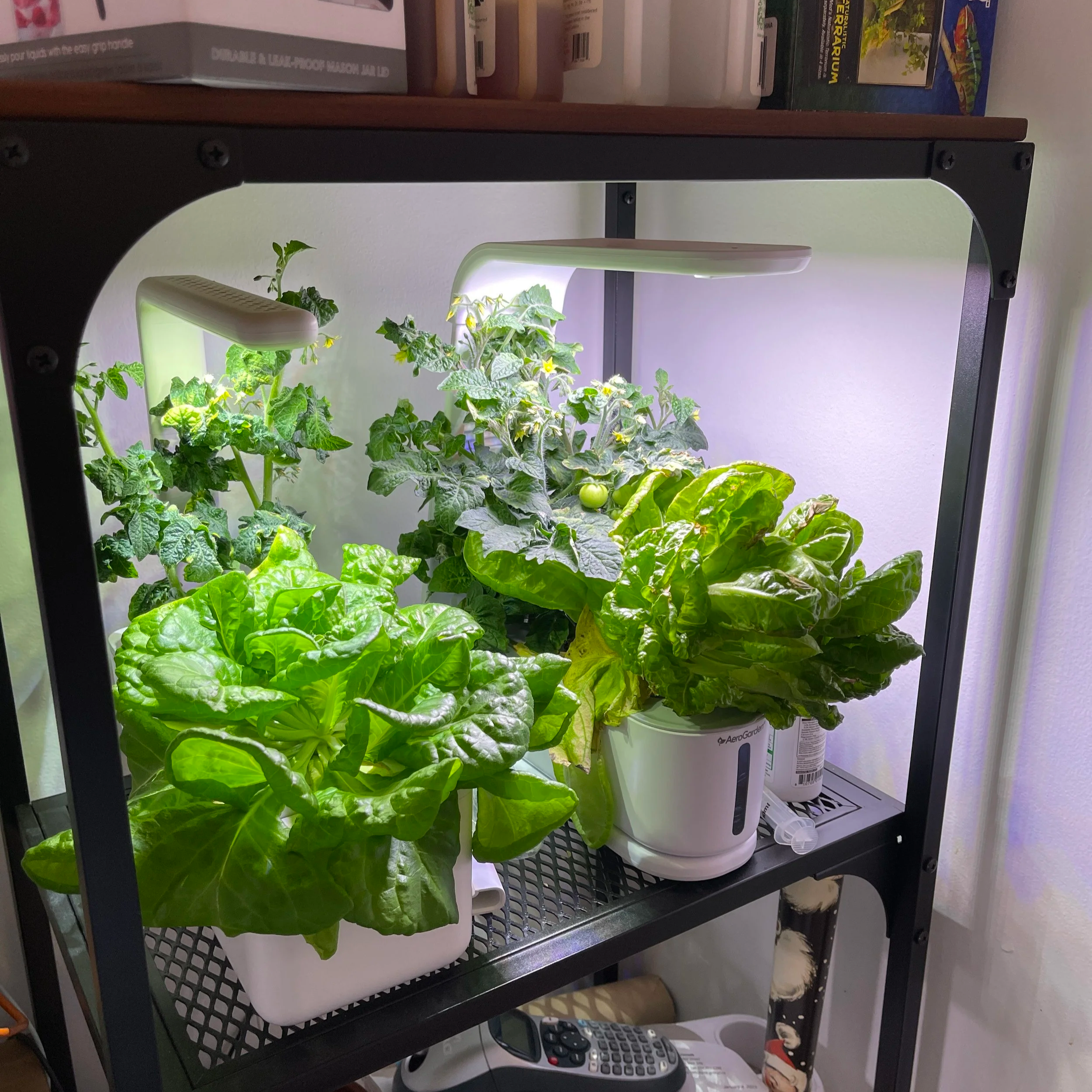
📆 Three Months Later: The Results
After three months, the differences were impossible to ignore.
🥬 Lettuce Results
Both systems eventually produced harvestable lettuce. However:
AeroGarden
Faster germination
Faster growth
Larger harvest
Better overall performance
Click and Grow
Required reseeding
Slower growth
Smaller overall plant
While the Click and Grow lettuce eventually caught up somewhat, it never matched the speed or vigor of the AeroGarden.
🍅 Tomato Results
This is where the biggest difference appeared.
Click and Grow Tomato
The plant:
Produced many flowers
Grew tall and leggy
Showed signs of nutrient stress
Produced only a few tomatoes
After three months, I counted just a handful of fruits.
AeroGarden Tomato
The AeroGarden tomato:
Produced abundant flowers
Developed a healthier structure
Set significantly more fruit
Produced approximately 13 ripe tomatoes during harvest
What's even more impressive is that I wasn't perfectly consistent with nutrient additions during the experiment.
Even with occasional neglect, the AeroGarden dramatically outperformed the Click and Grow.
🤔 Why Did the AeroGarden Perform Better?
I think there are several reasons.
1. Larger Root Space
One of the biggest differences is root development.
In the AeroGarden, roots can freely expand into the reservoir.
For larger crops like tomatoes and peppers, this creates a much larger root system.
In the Click and Grow, roots remain largely confined to the Smart Soil pod and wick system.
For small herbs or lettuce, this may not matter much. For fruiting plants, it appears to be more of a limitation. I should note that Click and Grow has since come out with what they call pro-cups. These have small slits that allow roots to enter into the reservoir BUT remember it is just water down there. They have also come out with special grow pods that are supposed to be formulated for fruiting plants and they there have more nutrients built in.
2. Ongoing Nutrient Availability
The AeroGarden receives fresh nutrients every two weeks.
The Click and Grow relies entirely on the nutrients initially contained within the pod.
While that simplicity is appealing, fruiting crops are heavy feeders.
A tomato growing for several months may simply need more nutrition than the pod can consistently provide.
3. Water Circulation
The AeroGarden includes a pump that continuously circulates water.
The Click and Grow relies on passive wicking.
While both methods work, active circulation likely improves oxygen availability around the roots.
💕 Things I Liked About the Click and Grow
To be fair, there are some things the Click and Grow does well.
Simplicity
There are no nutrients to measure.
No pumps to maintain.
No feeding schedule to remember.
For someone completely new to indoor gardening, that simplicity can be appealing.
Quiet Operation
Because there is no pump, the system operates silently.
Some people may prefer this over hearing a water pump cycle throughout the day.
💕 Things I Preferred About the AeroGarden
For my growing style, the AeroGarden had several advantages.
Flexible Growing Options
Using Grow Anything pods means I can grow almost any variety I want.
Better Root Development
The unrestricted root zone makes a noticeable difference for larger crops.
Adjustable Light System
The light adjusts smoothly as plants grow.
Consistent Productivity
Most importantly, it simply produced more food.
My Final Verdict
After three months, my winner is the AeroGarden Sprout. That doesn't mean the Click and Grow is a bad system.
If your goal is maximum simplicity and minimal maintenance, the Click and Grow may be exactly what you're looking for.
However, if your goal is growing productive vegetables, lettuce, peppers, and tomatoes indoors, I believe the AeroGarden provides better long-term performance and greater flexibility.
The larger root zone, active water circulation, adjustable feeding schedule, and stronger plant growth gave it a clear advantage in this experiment.
For me, that's enough to make the AeroGarden Sprout the winner.
Related Reading
If you're considering an AeroGarden but aren't sure which model is right for your space, check out my complete AeroGarden comparison guide where I break down the features, sizes, and best uses for every AeroGarden model.