The Back to the Roots Aquaponic Fish Tank (also called the Water Garden) is a 3-gallon fish tank with a grow bed on top — the fish feed the plants, and the plants help filter the water. I used it for two months and wanted to give you an honest review, because the "self-cleaning" promise deserves a closer look.
Disclosure: Some of the links below are affiliate links, meaning, at no additional cost to you, I will earn a commission if you click through and make a purchase.
Quick Facts
🎥 Watch my honest 2-month review video
Overview
Aquaponics is a closed loop: fish waste feeds beneficial bacteria, the bacteria convert it into nitrates, and the plants take up those nitrates as food. In theory the system balances itself. In my two months with this tank, the loop worked — but it did not run itself, and the "self-cleaning" label oversells it.
The fish thrived, the tank looks sleek in a room, and it is a genuine conversation starter. But algae built up on the sides within two months, the leca pods needed regular cleaning, and this is a short-term-plant system, not a food garden.
What's Included
3-gallon tank
Grow bed + 3 grow pods
Puffed clay growstones (grow medium)
Radish microgreen + wheatgrass seeds
Fish food, water conditioner, submersible pump
Feeding hole on top, so you can feed the fish without removing the lid
One thing that was not in my box: gravel. The box picture shows gravel in the system, but mine came without it. I bought blue betta-safe gravel separately — one pound sounded like more than it is, so get 2 pounds if you want decent coverage on the bottom.
Setup Guide
Setup is straightforward: rinse the bed, sponge, and pods, add grow medium to the pods, sprinkle in seeds, place the grow bed on top of the tank, and let the pump carry water up to the plants. Microgreens take roughly 7–14 days.
If you want to watch me unbox and set up the whole tank, you can check out this video here:
🎥 Watch my setup video
Growing Conditions
This is a bacteria-driven system, and that sets the rules:
Don't change more than one pod's leca per day. The grow medium is home to the beneficial bacteria that keep the system balanced — swapping everything at once crashes that balance.
Microgreens are a 7–14 day crop here. Succession plant them if you want a continuous supply, rather than planting all three pods at once and harvesting everything the same week.
Fish choice matters at 3 gallons. One betta is the standard recommendation. Small fish like zebra danios or fancy guppies work in small numbers. Fish that grow large (like goldfish) will outgrow this tank.
Best Plants
What actually worked for me:
Radish microgreens and wheatgrass — the included seeds, grown as intended.
Pothos and spider plant — added later as houseplants, and they established strong roots that helped keep the tank cleaner.
What this tank is not for: long-term plants like tomatoes, or a serious herb garden. If you want tomatoes or herbs indoors, a hydroponic system like the AeroGarden Harvest or a Rise Garden is the better tool.
Maintenance
Honest version of the upkeep:
Clean the leca pods every 7–14 days. This is the time-consuming part, and it is non-negotiable if you grow microgreens.
Algae happens. After two months I had visible buildup on the sides. I stopped cleaning it for a while to see if the system would balance out on its own — it didn't.
Cleanup crew helps. Adding a snail and some blue shrimp started clearing the algae, and the pothos and spider plant roots helped too.
Replacing pods adds up. You can reuse leca, but only if you clean out all residual plant material thoroughly, and continual replacement gets expensive.
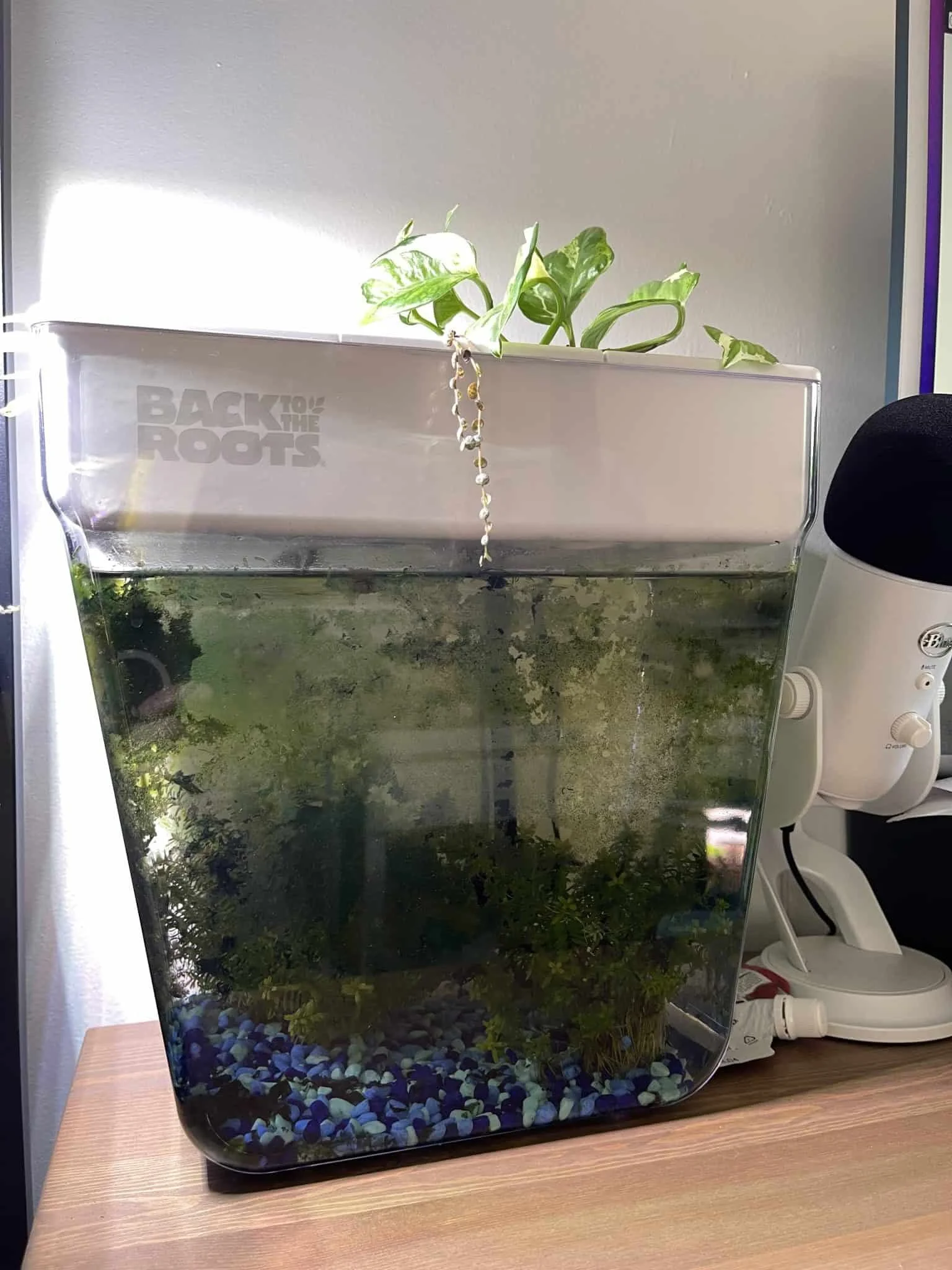
Algae Happens 😒
Anytime you have Light + Nutrients + Water you run the risk of algae. In any of the systems we use to grow food indoors you will have all three. The fishtanks makes it even worse as there is so much area that is exposed to light. I like ti use a small non-breeding snail to help control it.
Troubleshooting
Algae buildup: expect it, even with the "self-cleaning" claim. A snail and shrimp plus rooted houseplants helped mine, but they work through it gradually, not overnight.
Waterfall noise: the sound of water falling into the top of the grow deck was loud enough to be distracting. I came up with a fix, which I show in the setup video linked above.
No gravel in the box: buy 2 pounds of betta-safe gravel separately if you want the look from the box photo.
System out of balance: if you change pods, change only one per day so the bacteria levels stay high enough to keep the system stable.
Recommended Accessories
Blue betta-safe gravel (2 lbs)
A snail for algae control
Blue shrimp for algae control
Replacement leca / growstones
FAQ
-
Not in my experience. The aquaponic loop works, but algae built up within two months and needed cleaning. Think "lower maintenance," not "no maintenance."
-
Not long-term. It is built for short-term plants like microgreens, plus houseplants. For tomatoes or herbs, use a hydroponic system instead.
-
Every 7–14 days if you are growing microgreens, and only change one pod's leca per day to protect the beneficial bacteria.
-
Mine didn't, despite the box photo showing it. Budget for a bag of betta-safe gravel — 2 pounds covers the bottom properly.
-
One betta is the classic choice, or a few small fish like zebra danios or guppies. It is a 3-gallon tank, so anything that grows large will outgrow it.
-
Yes — that is one of its best uses. It is a hands-on way to show how fish, bacteria, and plants feed each other, and it looks great on a counter.
🤔 Final Verdict
The Back to the Roots Aquaponic Fish Tank is a unique, fun addition to a home — but buy it for the right reasons. As a decorative tank that grows houseplants and teaches aquaponics, it is genuinely charming. As a food-growing system, it is not: the pod cleaning is time-consuming, replacements add up, and it is not self-cleaning in the way the box suggests. If you want a fish and like growing plants, go in with eyes open about the maintenance and you will enjoy it.
🌱 Who Is This System Best For?
✔ Fish lovers who want plants on top of their tank
✔ Classrooms and hands-on learning
✔ Kids wanting a first fish
✔ Anyone wanting a decorative living piece in a room
✔ Growers happy with microgreens and houseplants
✔ Small spaces — it fits on a countertop
Not ideal for: gardeners wanting to grow tomatoes, herbs, or any long-term fruiting crop; anyone expecting a truly self-cleaning, hands-off system; or anyone who doesn't want a regular pod-cleaning routine.