Fruit flies in the house are the worst. They're tiny, they're everywhere, and they can make even your beautiful indoor garden feel… less beautiful. Ask me how I know!
Mine started with a mistake on my part with my worm bin. Before I knew it, I had a full-blown fruit fly infestation on my hands.
So I did what I do: I ran an experiment to find out which fruit fly traps actually worked.
And here's something that surprised me: the trap everyone seems to recommend first — apple cider vinegar — caught absolutely nothing in my experiment!
Instead, a rather unusual homemade bait came out on top.
If you're dealing with fruit flies in your indoor garden or grow room, here's what I tested, what worked, and the simple solution I still reach for today.
First, Are They Actually Fruit Flies?
Before you start setting traps, make sure you're dealing with fruit flies and not fungus gnats. They're easy to confuse, especially when you're growing plants indoors.
Fruit flies:
Usually tan, brownish or yellowish in colour, often with noticeable red eyes
Tend to hover around fruit, compost, fermenting materials and other decomposing organic matter
Are attracted to the smell of fermentation
Fungus gnats:
Small, dark insects that look a little like tiny mosquitoes
Often hang around moist growing media, pots and hydroponic growing areas
Their larvae develop in damp organic material and can sometimes damage young plant roots
The distinction matters because the traps and control methods aren't necessarily the same.
This post is about fruit flies. If you're dealing with tiny black flies around your growing media, you may actually have fungus gnats.
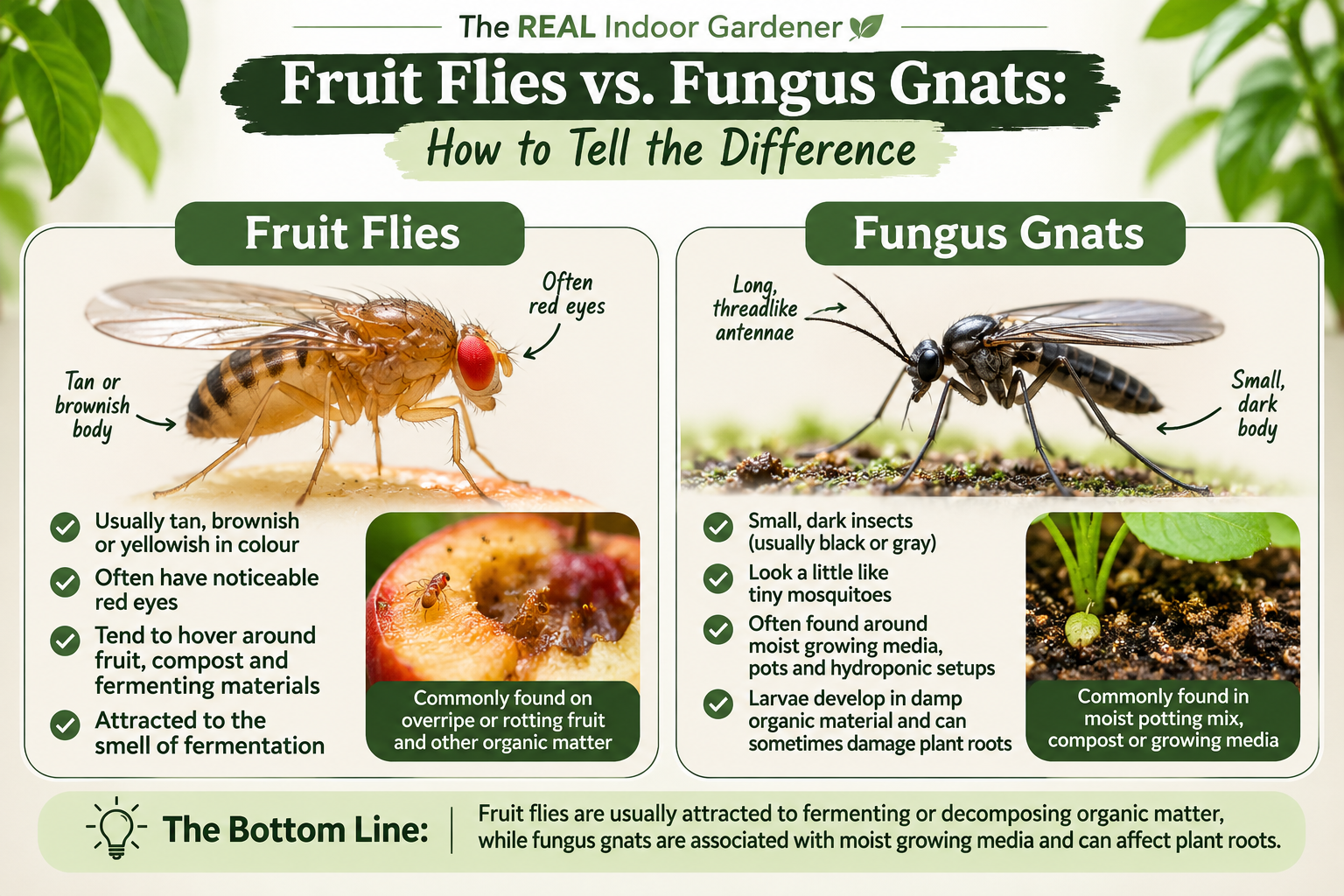
It is important to do your best to identify what flying foe you are dealing with as solution will be different for fruit flies vs fungus gnats.
Why Do Fruit Flies Love Hanging Out Indoors?
Indoors provides a comfortable environment for them, but it's usually not the plants themselves attracting them. It's whatever organic material is nearby.
Common sources include:
Worm bins and compost containers
Overripe fruit and vegetables
Fermenting tomato seeds
Food scraps and organic debris
Damp sponges and cleaning cloths
Organic material accumulating in trays or around growing areas
In my case, the worm bin was the culprit.
The good news? You don't have to throw out your hydroponic garden or start over. You need to find the breeding source, remove it, and deal with the adult flies that are already flying around.
I Tested 6 Fruit Fly Traps — Here's What Happened
Rather than just recommending the usual homemade fruit fly remedies, I wanted to see what actually attracted the most flies.
For my experiment, I set up several Mason jars with different baits. Each jar was covered with plastic wrap, with five small holes poked in the top to let the flies enter.
I placed them side by side on the kitchen counter and checked the results after approximately two days.
The results surprised me.
The clear winner was fermented tomato seed water.
I honestly wasn't expecting that. Apple cider vinegar is probably one of the most commonly recommended homemade fruit fly baits, but it didn't attract a single fly in my test.
And the leftover water from saving tomato seeds? It attracted more than I could count.
Of course, this was a small home experiment rather than a controlled scientific study, so your results may vary. But it was enough to show me which bait I wanted to keep using.
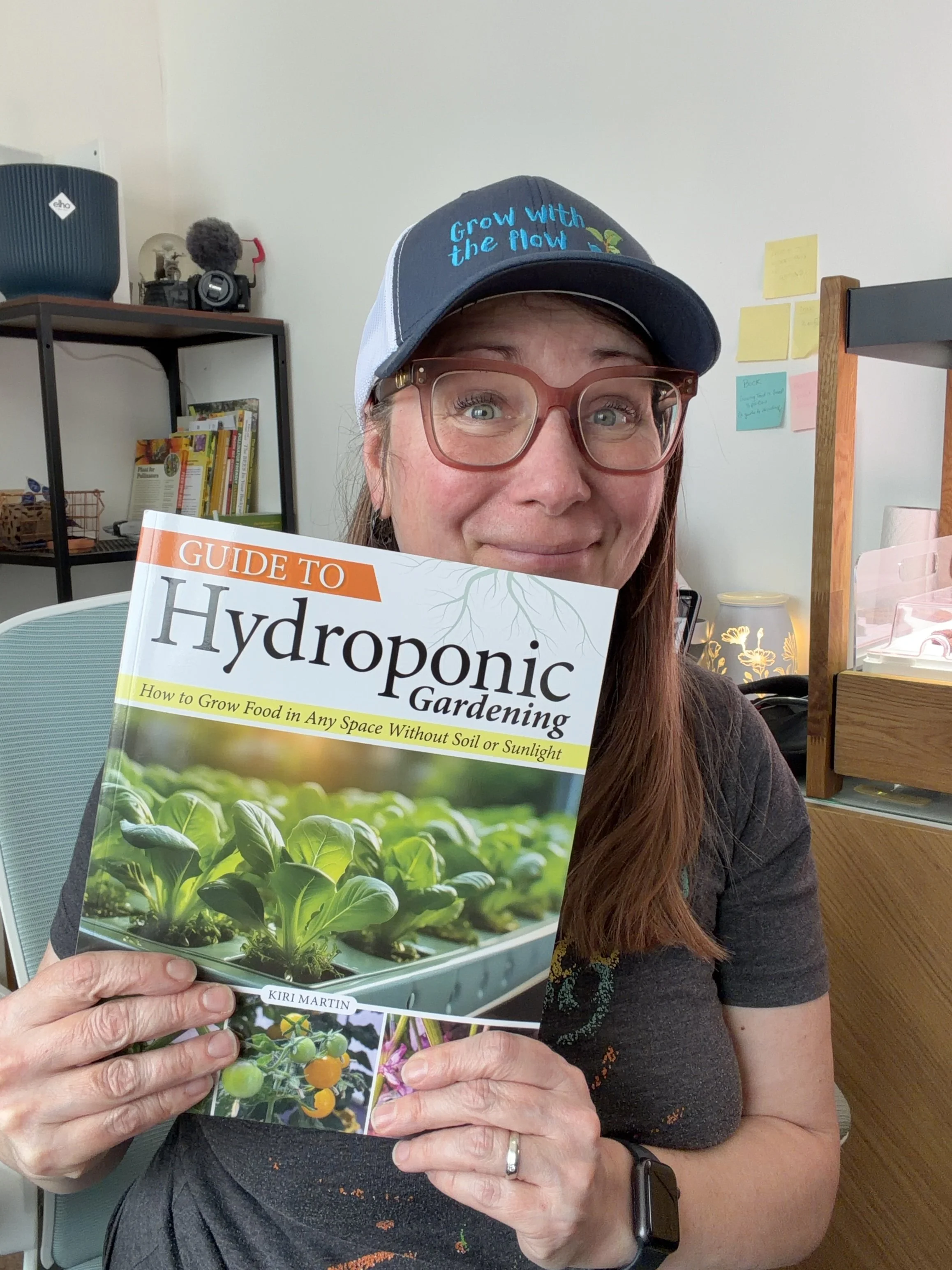
Want to Grow Your Own Food Hydroponically?
My book is packed with practical advice, tips and step-by-step guidance to help you grow fresh food in any space — without soil or sunlight. Whether you're a complete beginner or looking to expand your indoor garden, this guide will help you get growing!
What About Dish Soap? Should I Have Added It to the Traps?
This is probably the most common question I get about this experiment, so let's talk about it!
A lot of homemade fruit fly trap recipes recommend adding a few drops of dish soap to apple cider vinegar. There's a good reason for that.
Dish soap reduces the surface tension of the liquid, making it harder for flies to stay on the surface and escape once they land. Essentially, it helps turn an attractive liquid into a more effective drowning trap.
So why didn't I use it?
Because I wanted to compare the different baits under the same conditions.
I didn't add dish soap to the apple cider vinegar, but I also didn't add it to the fermented tomato seed water, honey, wine or any of the other options. Every liquid bait was tested without soap.
If I had added dish soap to only the apple cider vinegar, that would have introduced another variable and made the comparison less consistent.
Now, does that mean dish soap couldn't have improved the results? Absolutely not! It might have helped trap more flies in some of the jars.
And there's an important distinction here: my experiment measured how many flies were actually caught, not simply how many were attracted to each bait. Without dish soap, some flies may have landed on a liquid and escaped.
So, could apple cider vinegar perform differently with dish soap? Certainly. I haven't tested that combination separately.
But the point of my experiment was to see which bait performed best when everything else was kept as consistent as possible.
And under those conditions, fermented tomato seed water was the clear winner!
I'm not claiming this is the definitive scientific test of every possible fruit fly trap recipe. It's a real-world experiment I conducted in my own home, and I'm sharing exactly what happened.
The 3 Fruit Fly Traps I Still Use
After my experiment, I settled on three different solutions, depending on where I'm dealing with fruit flies.
1. Yellow Sticky Traps
These are my first line of defence in the grow room.
Yellow sticky traps are inexpensive, easy to use and catch flying insects that land on them. I keep them around my indoor growing area as an early-warning system.
If I start seeing flies on the traps, I know it's time to investigate before the problem gets worse.
They won't eliminate an infestation on their own, but they're useful for monitoring and reducing the number of adult insects.
Yellow Sticky Traps – The Ones I Use (Affiliate link)
2. Reusable Ceramic Fruit Fly Trap
It's a reusable ceramic trap that doesn't look like traditional pest control equipment sitting on the counter. I like having something that does the job without looking like I've turned my kitchen into a science experiment. While I still use this, that is mostly because I already own it and bought it BEFORE I found the mason top fruit fly trap lids noted below. So if you have mason jars then I would go for that option before this one.
Reusable Ceramic Fruit Fly Trap (Affiliate link)
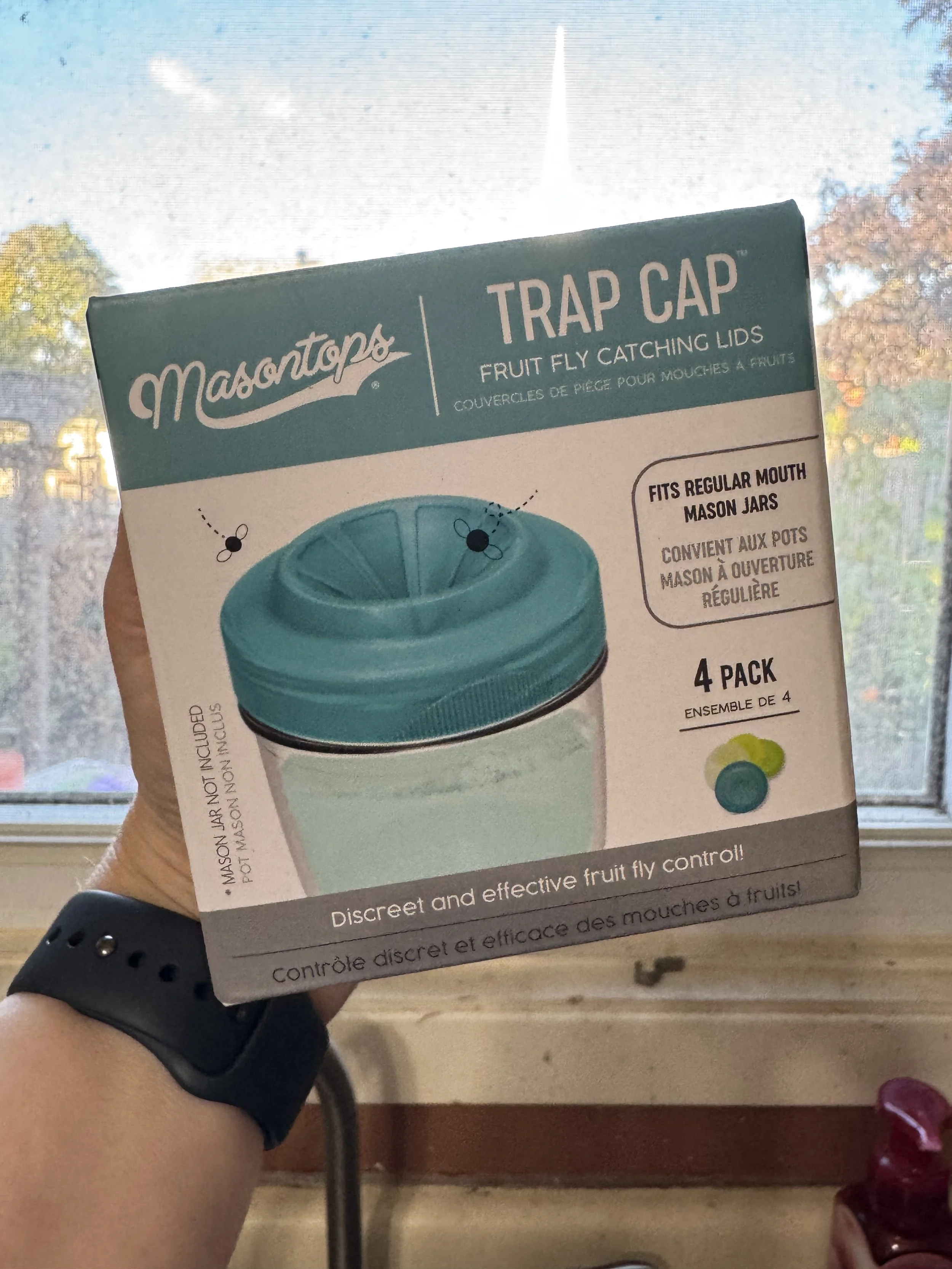
Not gunna lie….I love the Mason Tops brand and I bought these with my own money. I always have mason jars so any cool new ways for me to use them is always a win in my books!
3. Mason-Top Fruit Fly Trap Lids
This is my favourite solution and the one I reach for first now.
These lids turn an ordinary Mason jar into a reusable fruit fly trap. Add your bait, screw on the lid using the jar ring, and let it do its thing.
No complicated DIY project, no fiddly plastic wrap, and no need to keep making a new trap from scratch.
Mason Tops Fruit Fly Trap Lids (Affiliate Link)
The real secret, though, is what's inside the jar.
My Secret Weapon: Fermented Tomato Seed Water
This is the bait that won my experiment, and I actually discovered it completely by accident.
When I was saving seeds from my tomatoes, I noticed fruit flies gathering around the paper towel covering my fermenting seed jars.
That got me thinking. If the flies were so attracted to the fermenting tomato seeds, why not use that as bait?
So I tested it, and the results were pretty impressive.
How to Make Fermented Tomato Seed Water
You don't need anything fancy.
What you'll need:
One ripe tomato (I used a homegrown Lucky Tiger)
A small Mason jar
A little water
The tomato seeds, pulp and jelly
How to make it:
Squeeze the tomato into your jar, including the seeds and surrounding jelly.
Add a little water to create a loose mixture.
Leave the mixture to ferment for approximately four days.
Once fermentation gets going, add some of the liquid to your fruit fly trap.
Attach your Mason-top fruit fly lid and place the trap where you're seeing flies.
I didn't add dish soap to my traps during the experiment, and the fermented tomato seed water still attracted plenty of flies.
One thing to keep in mind: I haven't established a specific refresh schedule. I simply make a fresh batch when the existing bait stops attracting flies.
And because this is fermenting organic material, keep the bait contained inside the trap and away from your hydroponic reservoir and growing equipment.
Why Does It Work?
Fermenting fruit and vegetable material produces odours that attract fruit flies.
The fermented tomato seed mixture appears to be particularly attractive to the flies I was dealing with.
I can't say it's the best bait for every species or every situation, but based on my experiment, it's the one I'll keep using.
Mason-Top Fruit Fly Trap Lids (Affiliate link)
How to Prevent Fruit Flies From Coming Back
Here's the part that really matters.
Traps are great for catching adult flies, but if you don't eliminate the source, you'll keep catching more.
Fruit flies reproduce quickly, so you need to interrupt that cycle by removing the places where they're laying eggs and developing.
Here's what I recommend:
1. Find the Source
This is the most important step.
Check your worm bin, compost, kitchen garbage, fruit bowl and anywhere organic material might be decomposing.
Don't assume you know where they're coming from. I once had a banana that had fallen behind something, and that was enough to create a problem!
2. Keep Organic Material Contained
Don't leave food scraps sitting around, empty your compost regularly, and keep fruit in the refrigerator when possible.
Pay particular attention to your grow room. Remove dead leaves, fallen plant material and anything else that might be decomposing.
3. Keep Your Growing Area Clean
Wipe down surfaces, clean up spills and check underneath your hydroponic systems and growing trays.
Even small amounts of organic debris can become an attractive breeding site.
4. Keep Yellow Sticky Traps in Place
Even when you don't have an obvious infestation, sticky traps are useful for monitoring.
Think of them as your early-warning system. A couple of flies caught on a trap gives you a chance to investigate before you have a much bigger problem.
5. Be Patient and Consistent
Don't assume the problem is solved after one good day of trapping.
Keep monitoring and trapping for at least a couple of weeks after removing the source. If you're still seeing flies, go back and investigate for another breeding site.
The goal is to eliminate the source and stop the next generation from developing, not just catch the adults you can see.
Frequently Asked Questions About Fruit Flies
-
They're mostly a nuisance — the adults don't eat your plants, but a big population means eggs and larvae wherever there's damp organic matter, and nobody wants that near food they're growing. Worth dealing with, not worth panicking over.
-
It depends on how large the infestation is and whether you've found the breeding source.
You may notice fewer adult flies within a few days of setting traps, but completely eliminating an infestation can take longer. Keep monitoring for at least a couple of weeks after removing the source.
-
They can help reduce adult populations, but they aren't a complete solution.
Sticky traps catch adults, but they won't eliminate eggs or larvae developing in a breeding source. You need to remove the source as well.
-
Apple cider vinegar is a popular homemade fruit fly bait, but it didn't work in my experiment.
I tested it alongside several other baits, and it caught zero flies. Fermented tomato seed water was the clear winner in my test.
Your results may differ, but I know which one I'll be reaching for!
Want to Grow Your Own Food Hydroponically?
My book is packed with practical advice, tips and step-by-step guidance to help you grow fresh food in any space — without soil or sunlight. Whether you're a complete beginner or looking to expand your indoor garden, this guide will help you get growing!
Final Thoughts
Fruit flies are frustrating, especially when you're trying to keep your indoor garden clean and healthy. But you don't need to panic or throw out your plants.
My advice?
Find the source first. Whether it's a worm bin, compost container or a forgotten banana, eliminate whatever is attracting and breeding the flies.
Catch the adults. Yellow sticky traps are great for monitoring your grow room, and a baited trap can help deal with the flies already flying around.
Find our secret weapon (fermented tomato seed water for me) but don’t be scared to try something new!
And remember, keep monitoring for a couple of weeks after you've dealt with the problem.
Happy indoor gardening! 🌱